






Aboriginal Health and Medical Research Council of NSW 2014
Day 2 Summary
Session Four: Moving Forward
This session was designed to give a range of views on the progress, outcomes and future directions of tobacco programs from a national to a local ACCHS perspective. National Perspective: Dr Tom Calma AO, National Coordinator Tackling Indigenous Smoking (TIS), Department of Health (via video presentation) Tom apologised for not being able to attend the Symposium and acknowledged the traditional owners and elders past and present. Tom’s presentation outlined the TIS program, its reach and focus including: 300 TS&HL workers in teams across the country
workforce training
national coordination and governance
enhancement of existing Quitline services
national social marketing campaigns
formative research looking at what works for Aboriginal and Torres Strait Islander tobacco
control policies.
Tom also provided an outline of the current status of the program: contracts have been extended until
31 March 2015 but funding ends December 2014, and there is a freeze on recruitment. This is being
implemented while the Department of Health (DOH) undertakes a review of the TIS program; the
review's findings will inform the DOH's decisions on the future form of the program. The review will
assess the available evidence of the effectiveness of programs in both Aboriginal and Torres Strait
Islander communities and other contexts through consultation with stakeholders and a literature
review. Tom advised that services needed to think about how they wished to contribute to the review
and what evidence would best demonstrate the achievements of their programs e.g. video, photos,
data, resources, policies.
Tom emphasised that the intention is to continue the program in some form beyond June 2015.
“It’s in your hands, you’re on the ground, you’ve got the
evidence”
Q & A:
There were a range of questions and comments around issues of data collection and evidence
in particular in relation to the difficulty of measuring health promotion programs (like the TS&HL
program) in the short term. AH&MRC advised delegates not to rush out and collect new data for
the review, but rather to focus on the power of the stories of what they have achieved in their
communities. Melissa Romeo supported this view and urged delegates to talk about the ‘spirit of
change’, to include narrative, and to communicate in a way that is meaningful to Aboriginal
communities.
State Perspective (AH&MRC): Jasmine Sarin, Senior Tobacco Coordinator, AH&MRC
Jas acknowledged the traditional custodians and thanked everyone for coming to the Symposium,
which keeps getting bigger and better every year. Jas highlighted the key outcomes of the AH&MRC
A-TRAC program since 2010, focusing particularly on partnerships, resources, campaigns and
engagement with ACCHSs. Jas concluded by outlining plans for Phase Two of the A-TRAC program
which began in 2014 and includes new partnerships, some deadly resources and better
communications.
State Perspective (Ministry of Health): Audrey Maag, Acting Manager, Strategic and
Regulatory Policy, NSW Ministry of Health
Audrey manages the tobacco branch at NSW Health and her presentation focused on the
implementation of smoke –free environment policies. Aboriginal communities are one of the priority
populations for the branch and Audrey outlined current initiatives which seek to denormalise smoking,
reduce exposure to second hand smoke and support quitters.
Audrey discussed a new Tobacco Public Notice Campaign, noting that stakeholder success was vital
to its success and that social media was proving effective in getting the message out to communities,
(e.g. high engagement with smoke free notices showing photos of children at sporting grounds).
Audrey ended by saying that the department is looking for advice on how to best implement smoke
free policies in Aboriginal communities.
Q & A
A question was again raised about accessing data and Audrey was happy to provide access to
NSW data which showed the drop in Aboriginal smoking rates to support ACCHSs evidence
base if requested.
The issue was also raised of targeting hospitals and training nurses in Nicotine Replacement
Therapy (NRT) to support smoking cessation in patients. Audrey explained that NSW Health has
limited power over Local Health Districts (LHDs) to prescribe changes but that they are focusing
on having a better understanding of who does what in clinical care and smoking cessation.
ACCHS Perspective: Chanel Webb and Perri Chapman, Winnunga Nimmityjah (ACT)
Chanel and Perri gave an overview of the Winnunga Nimmityjah Aboriginal Health service and their
role as tobacco workers who try to capture broad community needs. They focused on three research
projects: TATS, The Smoke Ring and No More Boondah and outlined what they learned from data
collection and evaluation from each of the projects, looking in particular at cessation rates, second
hand smoke impacts, smoke free places and homes, and referral processes for quitters. Education
and community campaigns were seen as a key to denormalising smoking in communities and the
importance of creating holistic programs was emphasised.
300 TS&HL workers in teams across the country
workforce training
national coordination and governance
enhancement of existing Quitline services
national social marketing campaigns
formative research looking at what works for Aboriginal and Torres Strait Islander tobacco
control policies.
Tom also provided an outline of the current status of the program: contracts have been extended until
31 March 2015 but funding ends December 2014, and there is a freeze on recruitment. This is being
implemented while the Department of Health (DOH) undertakes a review of the TIS program; the
review's findings will inform the DOH's decisions on the future form of the program. The review will
assess the available evidence of the effectiveness of programs in both Aboriginal and Torres Strait
Islander communities and other contexts through consultation with stakeholders and a literature
review. Tom advised that services needed to think about how they wished to contribute to the review
and what evidence would best demonstrate the achievements of their programs e.g. video, photos,
data, resources, policies.
Tom emphasised that the intention is to continue the program in some form beyond June 2015.
“It’s in your hands, you’re on the ground, you’ve got the
evidence”
Q & A:
There were a range of questions and comments around issues of data collection and evidence
in particular in relation to the difficulty of measuring health promotion programs (like the TS&HL
program) in the short term. AH&MRC advised delegates not to rush out and collect new data for
the review, but rather to focus on the power of the stories of what they have achieved in their
communities. Melissa Romeo supported this view and urged delegates to talk about the ‘spirit of
change’, to include narrative, and to communicate in a way that is meaningful to Aboriginal
communities.
State Perspective (AH&MRC): Jasmine Sarin, Senior Tobacco Coordinator, AH&MRC
Jas acknowledged the traditional custodians and thanked everyone for coming to the Symposium,
which keeps getting bigger and better every year. Jas highlighted the key outcomes of the AH&MRC
A-TRAC program since 2010, focusing particularly on partnerships, resources, campaigns and
engagement with ACCHSs. Jas concluded by outlining plans for Phase Two of the A-TRAC program
which began in 2014 and includes new partnerships, some deadly resources and better
communications.
State Perspective (Ministry of Health): Audrey Maag, Acting Manager, Strategic and
Regulatory Policy, NSW Ministry of Health
Audrey manages the tobacco branch at NSW Health and her presentation focused on the
implementation of smoke –free environment policies. Aboriginal communities are one of the priority
populations for the branch and Audrey outlined current initiatives which seek to denormalise smoking,
reduce exposure to second hand smoke and support quitters.
Audrey discussed a new Tobacco Public Notice Campaign, noting that stakeholder success was vital
to its success and that social media was proving effective in getting the message out to communities,
(e.g. high engagement with smoke free notices showing photos of children at sporting grounds).
Audrey ended by saying that the department is looking for advice on how to best implement smoke
free policies in Aboriginal communities.
Q & A
A question was again raised about accessing data and Audrey was happy to provide access to
NSW data which showed the drop in Aboriginal smoking rates to support ACCHSs evidence
base if requested.
The issue was also raised of targeting hospitals and training nurses in Nicotine Replacement
Therapy (NRT) to support smoking cessation in patients. Audrey explained that NSW Health has
limited power over Local Health Districts (LHDs) to prescribe changes but that they are focusing
on having a better understanding of who does what in clinical care and smoking cessation.
ACCHS Perspective: Chanel Webb and Perri Chapman, Winnunga Nimmityjah (ACT)
Chanel and Perri gave an overview of the Winnunga Nimmityjah Aboriginal Health service and their
role as tobacco workers who try to capture broad community needs. They focused on three research
projects: TATS, The Smoke Ring and No More Boondah and outlined what they learned from data
collection and evaluation from each of the projects, looking in particular at cessation rates, second
hand smoke impacts, smoke free places and homes, and referral processes for quitters. Education
and community campaigns were seen as a key to denormalising smoking in communities and the
importance of creating holistic programs was emphasised.
Keepad Activity Results
Delegates were asked a series of questions and were instructed to reply using a Keepad to select their corresponding answers. The first question, represented by the pie chart was a fun practice question to get delegates used to using the Keepads. The second graph represents responses to the question: “Please select which best describes your situation. The video from Tom Calma was the first opportunity to learn directly from the Commonwealth Government about national policy decisions in relation to outcomes for Aboriginal communities in tobacco resistance and control in the last: 0-6 months, 6-12 moths, 12 months +, and irst time to hear about this information.” With the majority (66.5%) of delegates identified as being from ACCHSs 25% of those dlegeats had heard about the information given by Tom within the last 6 months, however a large portion (53%) of all delegates were hearing this for the first time. Delegates were also sked about wether or not the information they were hearing from various presenters was new. To do this response categroies were split into 6 monthly time periods to see how new the information was for delegates. The chart below deonstrates that delegates were hearing information from all types of organisations for the first time. This is a great way to look at improvements in commuications and how information is delivered to those woking in addressing Aboriginal tobacco resistanc and control. 42% of delegtes were hearing new information from AH&MRC for the first time with 23% of delegates having herd the information within the last 6 months. Information from the AH&MRC was an overview of the A-TRAC Program and the evaluation highlights over the last 3 years. this is starkly different for NSW State Government which showed 67% of delegates were hearing such informatio for the first time and 23% having heard it in the last 6 months. The information was regarding changes in legislation and what this entails for smoke free areas. A Local ACCHS presentation on how they have used research data and evaluated programs to plan thier activities showed 36.5% of delegates were familiar with the content and had heard this in the last 6 months. Just over half of the delegates were hearing this for the first time. Overall, on average, 54% of delegates had heard new information for the first time. State Perspective (AH&MRC): Jasmine Sarin, Senior Tobacco Coordinator, AH&MRC Jas acknowledged the traditional custodians and thanked everyone for coming to the Symposium, which keeps getting bigger and better every year. Jas highlighted the key outcomes of the AH&MRC A-TRAC program since 2010, focusing particularly on partnerships, resources, campaigns and engagement with ACCHSs. Jas concluded by outlining plans for Phase Two of the A-TRAC program which began in 2014 and includes new partnerships, some deadly resources and better communications. State Perspective (Ministry of Health): Audrey Maag, Acting Manager, Strategic and Regulatory Policy, NSW Ministry of Health Audrey manages the tobacco branch at NSW Health and her presentation focused on the implementation of smoke –free environment policies. Aboriginal communities are one of the priority populations for the branch and Audrey outlined current initiatives which seek to denormalise smoking, reduce exposure to second hand smoke and support quitters. Audrey discussed a new Tobacco Public Notice Campaign, noting that stakeholder success was vital to its success and that social media was proving effective in getting the message out to communities, (e.g. high engagement with smoke free notices showing photos of children at sporting grounds). Audrey ended by saying that the department is looking for advice on how to best implement smoke free policies in Aboriginal communities. Q & A
A question was again raised about accessing data and Audrey was happy to provide access to
NSW data which showed the drop in Aboriginal smoking rates to support ACCHSs evidence
base if requested.
The issue was also raised of targeting hospitals and training nurses in Nicotine Replacement
Therapy (NRT) to support smoking cessation in patients. Audrey explained that NSW Health has
limited power over Local Health Districts (LHDs) to prescribe changes but that they are focusing
on having a better understanding of who does what in clinical care and smoking cessation.
ACCHS Perspective: Chanel Webb and Perri Chapman, Winnunga Nimmityjah (ACT)
Chanel and Perri gave an overview of the Winnunga Nimmityjah Aboriginal Health service and their
role as tobacco workers who try to capture broad community needs. They focused on three research
projects: TATS, The Smoke Ring and No More Boondah and outlined what they learned from data
collection and evaluation from each of the projects, looking in particular at cessation rates, second
hand smoke impacts, smoke free places and homes, and referral processes for quitters. Education
and community campaigns were seen as a key to denormalising smoking in communities and the
importance of creating holistic programs was emphasised.
Information stalls were set up throughout the Symposium to allow delgeates to share information and
contact details via a shared laptop. Delegates were able to upload program resources and relevant
information for other delegates to download as need be. This was a great initiative of the Advisory
Group and will hopefully continue to develop in future Symposiums.
Session 6: Learning from Each Other – What’s Working Well?
Tobacco Initiatives in the Kimberley: David Batty and Shaun Sullivan, Kimberley AMS David and Shaun acknowledged the traditional owners and elders of the land and gave an overview of the local programs and strategic, statewide initiatives the team has delivered in Western Australia including the Aboriginal Corporate Games Challenge, Nuff of the Puff and the Comedy Road show. As the only educator in the Kimberley region and with five team members, David described the importance of being part of a statewide strategic team which shares ideas and resources and works together to achieve their common goals including tackling smoking in communities and workforce development. Community engagement is a key to the success of their programs and David and Shaun demonstrated how working with local community, youth and elders groups and collaborating with and gaining sponsorship from local agencies, has created hugely popular health promotion events in which thousands of local people have participated. Q & A:
A question was asked about how to gain sponsorship for local events and David described how
they approach local community organisations, offer advertising and explain that donations are
tax deductible as an enticement for sponsorship.
Working Together to Tackle Tobacco: Darren Kershaw, Bulgarr Ngaru
Darren acknowledged the traditional owners and commented on how much he learned from the
smoking ceremony which opened the Symposium. He gave an overview of a range of programs that
his team runs in the Grafton area including the Quit Café, Solid Mob and Healthy Thursday and
described how due to the large area they cover, the success of these programs relies on partnership
with other agencies including Medicare Locals and hospitals.
Darren used statistics from the TATS (Talking About The Smokes) research project to demonstrate
smoking status, quit attempts and awareness and support for smoking bans amongst the local
population. Darren also highlighted the need to increase the focus from just tobacco cessation to
broader health promotion. Key success factors to programs are to build a long-term relationship with
the community, target schools, and use local role models and elders to spread the message.
Djurali Program: Sophia Malie, Tharawal AMS
Sophia demonstrated the successes and challenges of the Djurali program including the importance
of community engagement and ownership of programs, collaborating with internal and external
partners including LHDs, Medicare Locals and Juvenile Justice, and difficulties posed by lack of
secure funding, staff turnover and the lack of formal referral pathways between health promotion
teams and clinicians.
Keepad Activity Results
The final Keepad activity showed that overall the Symposium had achieved its objectives of increasing workforce capaicty and providing networking opportunities for delegates. Of the 52 dleegates that completed all of the evaluation in this session 36 delegates strongly agreed that the Symposium has strenthened the workforce capacity in NSW to tackle tobacco use in Aboriginal communities. Of those 36 delegates, 33 (91%) identified as being either an Aboriginal Health Worker (33.5%) or Tobacco Action Worker/Health LIfestyle Worker (66.5%). When asked if the Symposium should be opened up to more poeple working in tobacco outside the ACCHS sector the majority (65%) agreed that an increase from all other organisations would be beneficial as shown in the graph below.






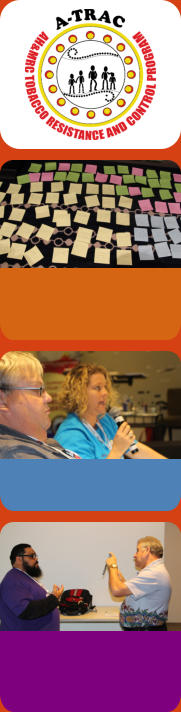
Evaluation doesn’t have to be
long. We had delegates using
post-it notes to let us know what
they liked and didn’t like!
Delegates had the opportunity to
talk about what matters to them
and their communities.
The Advisory Group sought
information by asking delegates
what they thoguht of the
Symposium using a HD video
camera.





